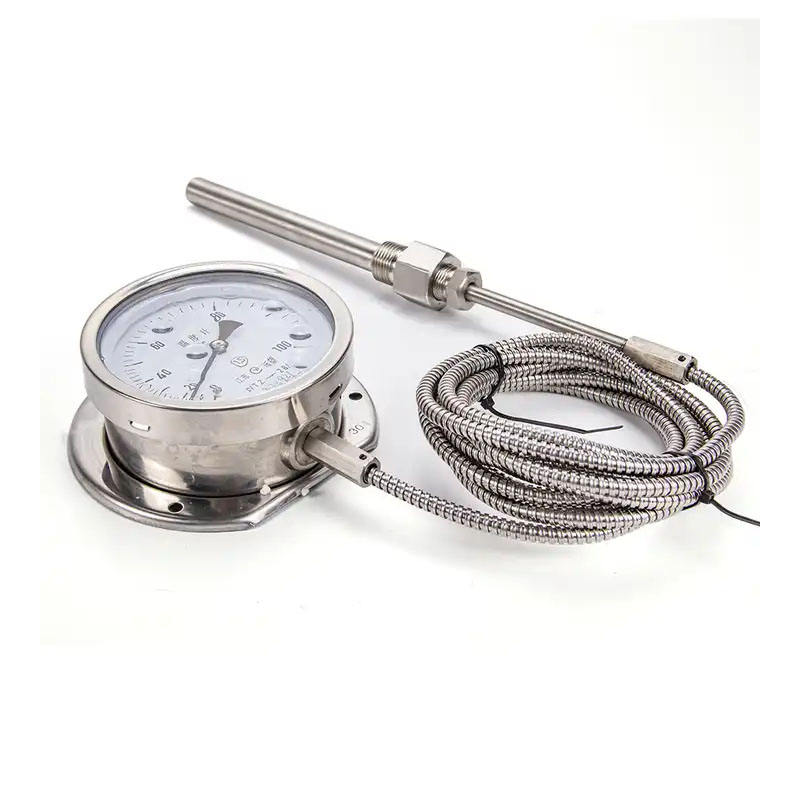
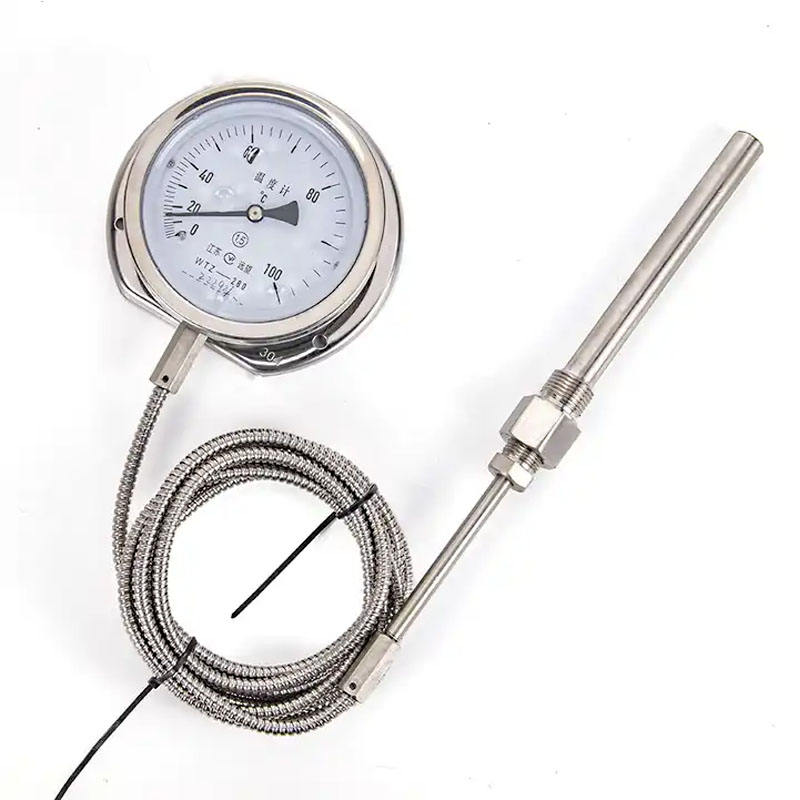
Capillary thermometers exist for one reason: the point where temperature has to be measured is rarely the point where someone can comfortably read a dial. This one puts a stainless steel probe in the pipe, duct or engine jacket and the dial wherever the operator actually looks — a panel at eye level, a bulkhead beside the boiler, the front of a processing cabinet.
The range runs from -50 to 600 °C across the series, so the same stainless steel oil-filled thermometer covers chilled water, jacket water, lube oil, boiler feedwater and superheated steam. It turns up in engine rooms, boiler houses and food plants for exactly that reason: one pattern, a long list of duties.
Most units are bought to replace a dial nobody could see, or to give an engineer a reading without opening a lagged pipe or leaning into a hot space. A ship's engineer reads jacket-water temperature from the panel; a boiler operator reads steam temperature from the walkway; a line supervisor reads the steam space of a processing steamer through the cabinet door. The instrument asks nothing more of them than a glance.
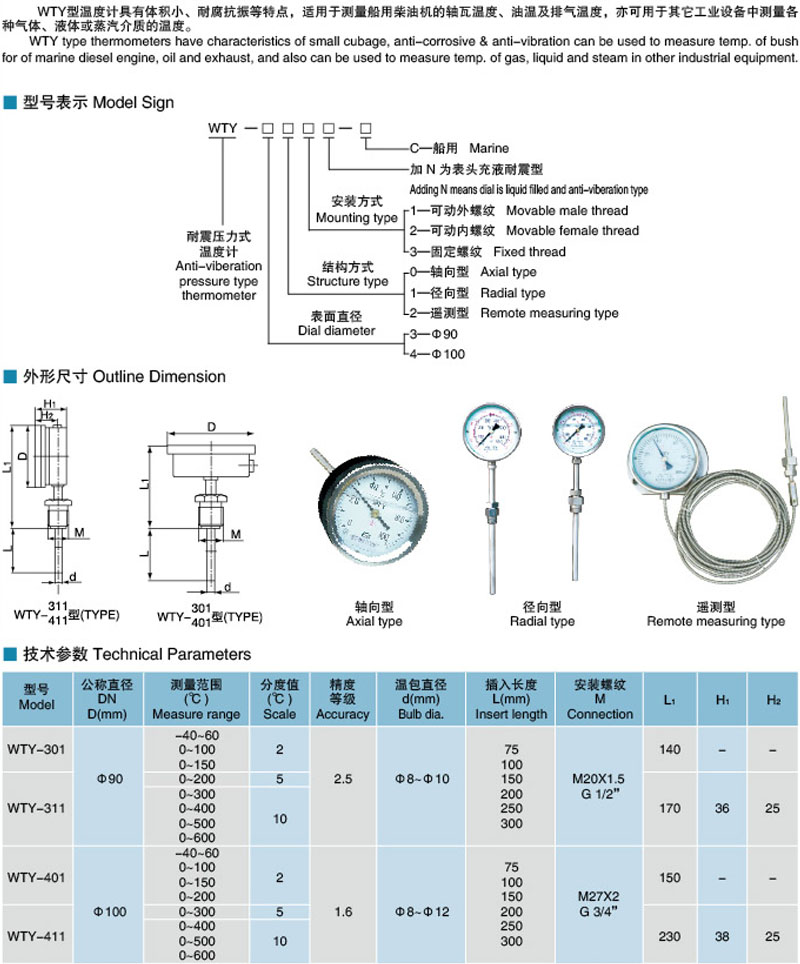
| Product Name | Capillary Thermometer |
| Type | WTY Series |
| Weight | 0.2KG |
| Range | -50 to 600℃ |
| Window | Glass or Plastic |
| Surface Diameter | 100mm |
| Probe Size | Default probe diameter 10mm thick, length 120mm long |
| Temperature Probe Material | Stainless Steel Material |
| Case Material | Stainless steel |
| Dial Fill | Liquid filled for vibration damping |
| Structure Type | Axial, radial or remote measuring |
| Mounting Connection | Movable male thread, movable female thread or fixed thread |
| Code prefix | WTY, liquid-filled pressure-type thermometer |
| N in the model code | Dial filled with liquid, anti-vibration version |
| Structure type 0 | Axial |
| Structure type 1 | Radial |
| Structure type 2 | Remote measuring, probe on a capillary with the dial mounted separately |
| Mounting type 1 | Movable male thread |
| Mounting type 2 | Movable female thread |
| Mounting type 3 | Fixed thread |
| Marine version | C code |
Precision is the first thing buyers ask about, and a filled system earns it honestly: the probe responds to the medium it sits in, the capillary carries that change with no linkage to wear, and the pointer lands on a printed scale that reads to a fine division. What the oil filling adds is steadiness. A dry dial on a running diesel engine shivers; a liquid-filled case damps that movement so the pointer holds a legible position even when the panel is vibrating under your hand. Corrosion resistance comes from the materials rather than a coating — case, probe and the parts that meet the medium are stainless steel, which is what keeps the unit serviceable in salt air, against fuel oil, and on steam lines that would eat a plated body. Then there is breadth: because one instrument covers water, steam, air and oil, a single spare on the shelf answers several tapping points, which matters when a vessel is weeks away from its usual port. Finally, repeatability. Once the range, thread and probe length are agreed, reordering from the same marine thermometer supplier keeps every replacement identical to the unit already on the panel.
The names on the old part. The same instrument travels under several names: oil-filled shock thermometer, shock oil-filled bimetal thermometer, liquid pressure-type remote transmission thermometer, and capillary thermometer. Supply catalogues use them side by side, and the reason is mostly habit — most dial thermometers on an engine or a steam line look alike from the front, so the word bimetal has become shorthand for the whole family even where nothing inside is bimetallic. This WTY series unit senses with a temperature-sensitive bulb charged with silicone oil; the change travels down the armored tube to the movement in the case, which makes it a true filled-system capillary thermometer rather than a bimetal instrument.
Telling the two apart. Look at the back of the case. A bimetal thermometer has a rigid stem running straight from the dial into the pipe, with the whole body sitting on the tapping point and the reading taken where the heat is. This stainless steel oil-filled thermometer has a flexible armored tube between probe and dial, and the dial is mounted on a panel, bracket or bulkhead somewhere else. If your old gauge was bolted directly to the pipe with a short stem behind it, you are replacing a bimetal; if a tube led away to a faceplate, you already had a capillary unit and the mounting will look familiar.
What that means for the order. Match the thread at the tapping, the probe diameter and immersion length, and the band the process actually runs in — the standard figures for all three are set out in the specification table above. Where the old bimetal was read on the spot and there is nowhere sensible to route a tube, a direct-mounting dial thermometer stays the practical answer; where the tapping is lagged, hot or high up, the remote reading is the upgrade. Either way, quote the numbers stamped on the old unit when you ask a marine thermometer supplier to confirm the match.
Buying instrumentation for a vessel or a plant usually comes down to matching the part to the job. Our team at Jiangmen Jiexi Machinery Equipment Co., Ltd. has worked with buyers worldwide since 2013, and we start before the order: confirming the range, thread, connection and mounting you need, checking a model or part number against the equipment on site, and saying plainly where a standard unit stops and custom work begins. After delivery we stay reachable for installation, commissioning and fault-finding, with quality control that includes two extra testing steps beyond industry standard.
The probe and dial on a capillary thermometer are joined by the armored capillary, and the length of that tube is what sets the distance. Measure the route the tube will actually take — from the tapping point, around pipework and bulkheads, to where the dial will be mounted — and tell us the figure; we will confirm the length that suits before the order is built. However long the run, leave a little slack at each end so the probe can be fitted and removed without straining the tube.
No. A bimetal thermometer carries its sensing element inside the stem, so the dial has to sit at the measuring point. This stainless steel oil-filled thermometer senses at the probe and transmits the change through a capillary, which is what lets the dial live on a panel, a bulkhead or the front of a cabinet instead. If your old unit was a direct-mounting dial and the reading needs to stay exactly where it was, a direct-mounting pattern is the right choice; if the reading needs to move, this is the one.
That is what the oil filling is for. The liquid in the case damps the movement, so the stainless steel oil-filled thermometer holds a legible position while the panel is vibrating, instead of shivering across half the scale the way a dry gauge does. The damping also spares the internal parts, which are no longer being shaken through their full travel every second.
Water, steam, air and oil are the four a marine diesel engine temperature monitoring thermometer is normally bought for, and other gases and liquids are within reach as long as the probe material and the range suit them. Steam and hot water at a boiler, air inside a duct, jacket water and lube oil on an engine, and the steam space of a processing steamer are all standard duties. If the medium is aggressive — seawater, chemical solutions, food product — say so before ordering so the wetted parts can be checked against it.
Both are offered, and the choice usually comes down to the site rather than to the instrument. Glass suits a face that is wiped or washed often and a position where radiant heat from a boiler or steam line reaches the dial. Plastic is lighter and shrugs off knocks, which helps where tools and cargo pass close by. Tell us how the dial will be cleaned and what it will be exposed to, and we will point you to the window that survives it.
Axial and radial both mount the dial directly on the stem; the difference is the direction the stem leaves the case, which decides whether the dial faces you from the top of a pipe or from its side. Remote measuring is the capillary pattern: the stem is replaced by a probe on a tube, and the dial goes wherever it can be read. Choose a direct pattern when the reading point and the tapping point are the same place, and remote measuring when they are not — which, on an engine or a lagged steam line, is most of the time.
Provided the range, thread and probe length are the same, yes — those three details decide the fit, so record them alongside the unit's location and quote them when you need another. Staying with the same marine thermometer supplier at least removes the guesswork, because the specification you already hold is the one the next unit is checked against.